
Academic
Transform long research papers, theses, and proposals into short summaries.
ACADEMIC RESEARCH AND WRITING
Transform study details and research notes into a publication-ready abstract that reflects the true background, methods, results, and conclusion.
The source and generated draft stay together so you can compare, verify, and refine the result without losing context.
Key components of an abstract
Define the research problem and its objectives.
Explain your approach, and then showcase your core findings.
Connect your findings to their wider significance.
Our space where your work comes to life
Keep all of the key components of your research paper or thesis in an editable workspace.
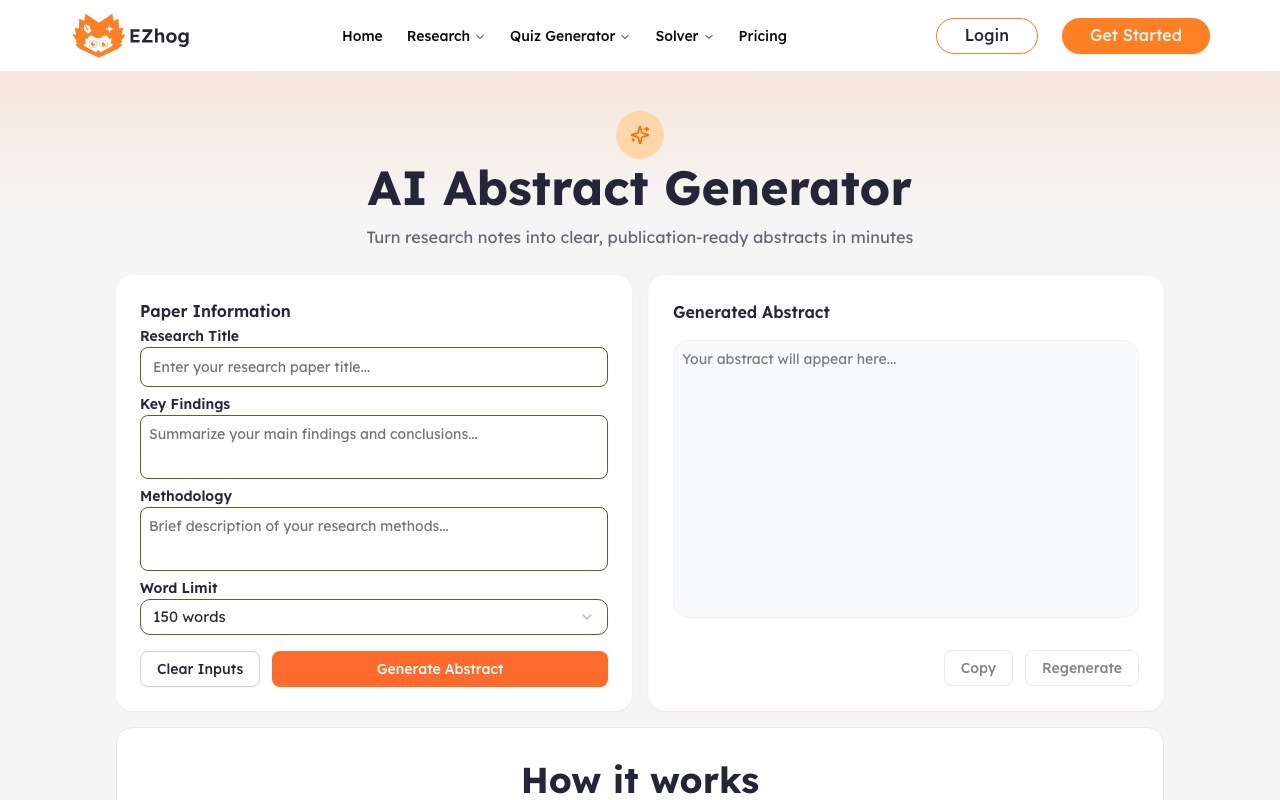
Use this abstract generator for a detailed understanding
Transform long research papers, theses, and proposals into short summaries.
Turn business documents into insights leaders can act on today.
Convert invention details into legal-ready, easy-to-understand overviews.
Rewrite technical content in plain language for everyday readers.
Make full use of your existing resources
Useful tips to follow
Keep within limits, add relevant keywords, and avoid unnecessary information.
FAQ
In research, an abstract is a short summary of a study. Usually, it is150 to 250 words long. It sits at the very start of a paper. The paper summarizes the main aim, methods, results, and conclusions of the work.
Yes, many modern AI abstract generators do support structured abstracts. They can structure content into standard labeled sections like Background, Methods, Results, and Conclusions (the IMRaD format).
Yes, abstract generators can make up facts, fill in bogus data, or guess information if you leave a field blank. They try to make a complete summary. They do not always know that your data is missing.
Yes, many AI abstract generators and academic writing assistants can extract or generate keywords alongside an abstract. This tool does so by analyzing the pasted text of a research paper or by working backward from the generated summary to identify core indexing terms.
Yes, abstract generators work in academic fields. However, their effectiveness depends on how well they are adapted to different structural and vocabulary norms (e.g., IMRaD for sciences vs. thematic narratives for humanities).
Yes, research data is stored confidentially. But it is under strict security regulations. Researchers securely store this data. So they can check their work, follow the law, and keep people's private data safe.