
Academic brainstorming
Generate research topic ideas in seconds and beat writer's block.
ACADEMIC RESEARCH AND WRITING
Create and assess research topic ideas based on the field of study, academic level, and optional interest areas.
The source and generated draft stay together so you can compare, verify, and refine the result without losing context.
From source to topic
Enter the source material or upload a supported document.
Include only the choices that shape your desired result.
Evaluate the output relative to the source, then either copy or regenerate.
Protected workstation
The two-panel layout keeps your source material visible as you review the generated result, chosen settings, and quality checks.
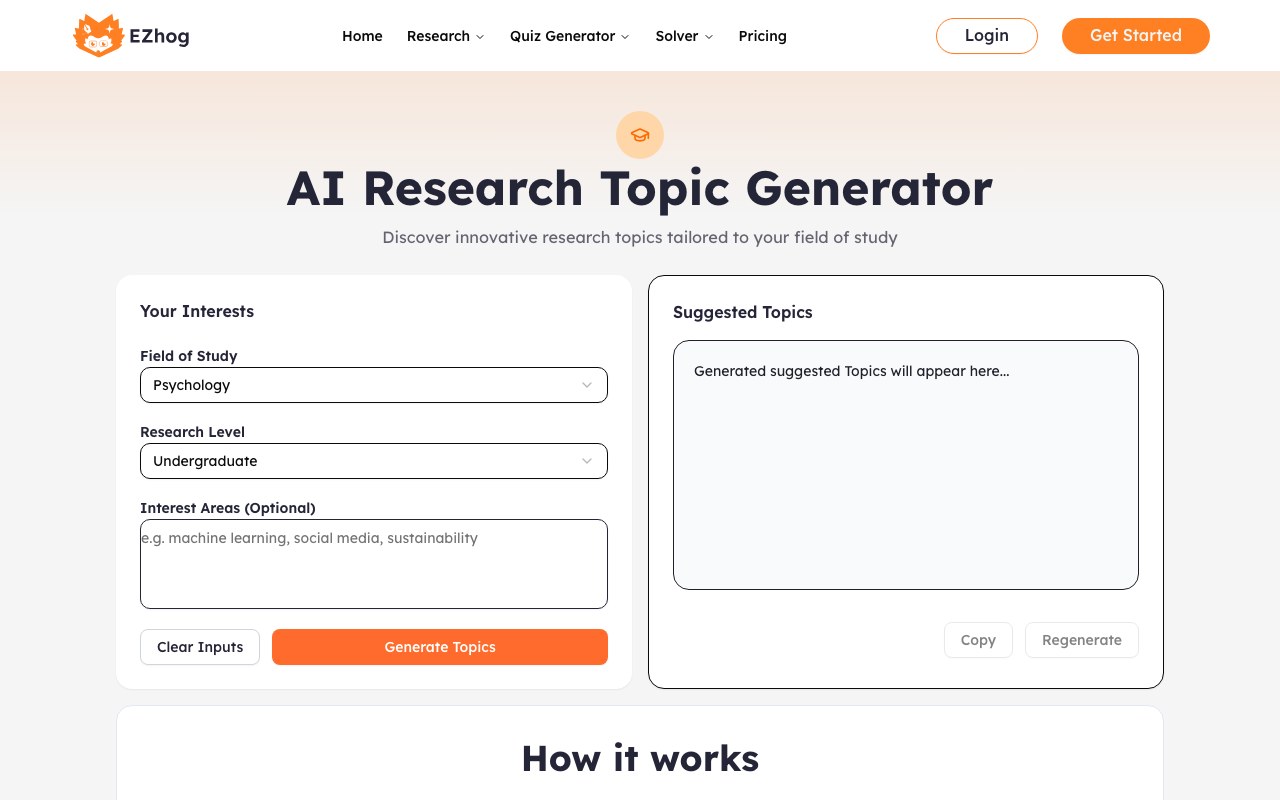
Utilize this thesis topic generator.
Generate research topic ideas in seconds and beat writer's block.
Guide entire student groups through early ideation using integrated tools.
Convert broad technical challenges into actionable research project parameters.
Combine study domains to generate novel interdisciplinary hypotheses.
Consider available resources while using this tool
Use AI results deliberately.
Double-check facts, citations, quotations, calculations, and institutional guidelines. Never share confidential research data or personally identifiable information with a public AI tool.
Common questions & answers
A research topic generator is an online tool. It uses artificial intelligence to help students and researchers brainstorm • academic project ideas, • paper subjects, or • thesis titles.
Yes, you can choose a field of study and research level when generating a research topic on EZhog’s platform. It will ensure the idea fits your specific field and study requirements.
Yes, I can generate both qualitative and quantitative research topics. You can completely customize them by specifying: • a country, • a target population, or • a particular industry.
EZhog’s AI research topic generator recommends data sources and citations while creating your research proposal topics.
Evaluate your project using four criteria: • novelty (check existing research and patents for gaps), • feasibility (assess resources, skills, and timeline), • ethics (secure approvals, consent, and reduce bias), and • data access (identify sources, permissions, and storage security).
For a strong topic workflow: you need to focus on extensive background research, verified data, and direct audience feedback.