
Literature review
Use this introduction paragraph generator to draft intro sections' background.
ACADEMIC RESEARCH AND WRITING
Match your writing goal to the right paragraph type to develop a focused paragraph from your topic.
The source and generated draft stay together so you can compare, verify, and refine the result without losing context.
From topic to paragraph
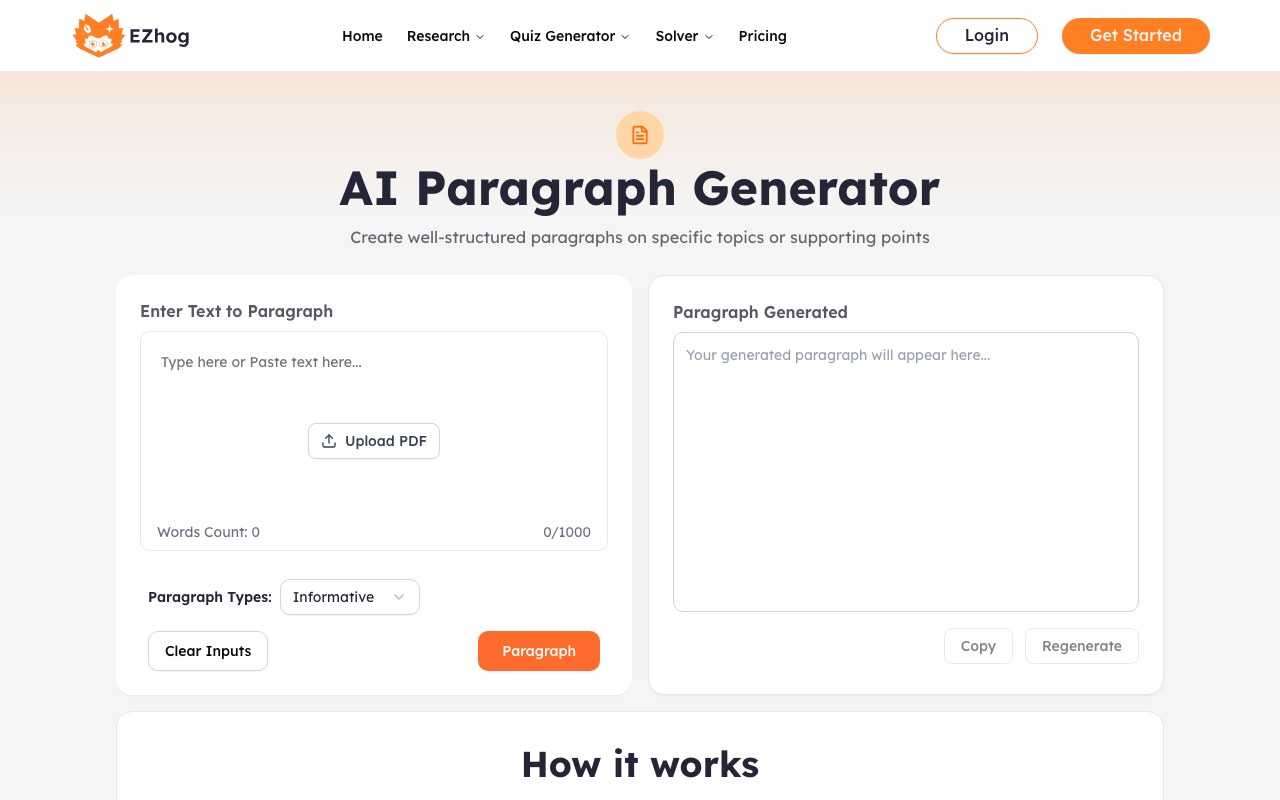
Type or paste the material or upload a supporting document.
Select only the options that change the output you need.
Compare the result with the source, then copy or regenerate it.
One protected workstation
The two-panel design keeps your source material in sight while reviewing outputs, settings, and quality checks.
Use this paragraph writer for research & writing
Use this introduction paragraph generator to draft intro sections' background.
Turn rough notes into structured paragraphs with angles and counterarguments.
Build practice questions or paragraphs to reinforce unit comprehension.
Create polished business writing for marketing, communication, proposals, & support.
Build from what you already have.
Use the AI outcomes in a dedicated manner
Check all facts, citations, quotations, and calculations, and confirm they meet institutional requirements. Do not enter confidential research data or personally identifiable information into any public AI tool.
Common questions & answers
An AI paragraph generator is an online software tool. It uses AI to write structured, logical paragraphs based on • simple user prompts, • keywords, or • topics.
Most modern AI paragraph generators allow you to choose the paragraph type (informative, argumentative, descriptive, narrative, or explanatory) before creating a paragraph. You can also set the approximate word count (upto 500 words) for the generated paragraph on EZhog’s platform.
Yes, most AI paragraph generators enable you to add your own facts and keywords. You can use the true "Keywords" or "Focus Terms" fields for exact words. Then, you can paste custom facts or notes into the topic/outline box for prompt instructions. Finally, the AI will automatically assemble the details you provided into a grammatically correct, orderly paragraph.
AI paragraph generators can produce both introductions and conclusions. For an intro: you need to provide a topic, thesis, or keyword. After that, the AI will create a hook plus an opening paragraph. To create a conclusion: you need to paste your body paragraphs or main points. Then, the AI summarizes your core arguments. Lastly, it will deliver a clear, concise final thought to wrap up the text.
To stop AI writing from sounding generic and robotic, you need to do two things. First, change how you prompt the AI. Second, edit the output carefully afterward. In some cases, AI writes sentences that are all the same length. It also tends to pick predictable, safe words. This makes the writing feel flat and repetitive.
Standard AI paragraph generators can create citations. But they often invent fake sources. AI models predict text from patterns, not real databases. So when asked for references, they make up realistic names, titles, and journals. Some tools use live web searches for real sources. But they still need manual checking.