
Coursework
Turn dense reading into a polished, submission-ready academic draft.
ACADEMIC RESEARCH AND WRITING
Turn a dense research paper into a structured summary highlighting intent, process, outcomes, limitations, and applications.
The source and generated draft stay together so you can compare, verify, and refine the result without losing context.
From source to summary
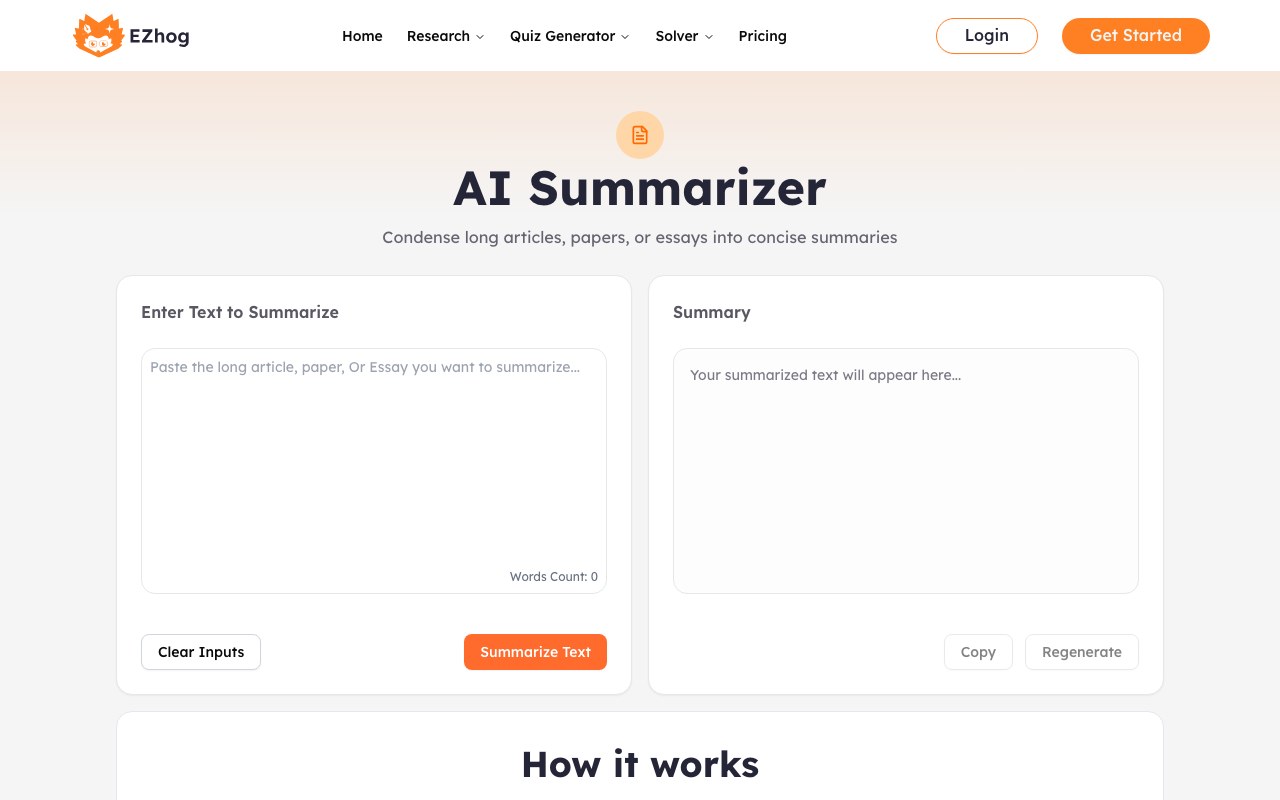
Paste the long text or attach a supported document.
Adjust how long your summary should be.
Match the output to the source, then copy or regenerate it.
All-in-one focused workstation
Review the generated result, settings, and quality checks, all while keeping your original context in view.
Use an AI summarizer for research and writing
Turn dense reading into a polished, submission-ready academic draft.
Structure questions, titles, summaries, and sections around a specific topic.
Build reports and structured documents with a consistent tone.
Enhance clarity and readability, with the final decision remaining yours.
Start with your in-hand resources
Apply AI results in a responsive way.
Double-check facts, citations, quotations, calculations, and institutional requirements. Keep confidential research data and personal information out of public AI tools.
Common questions & answers
A research paper summarizer (or academic article summarizer) is a digital tool. It reads a long, technical study and turns it into a short, concise summary. Most modern tools use AI and natural language processing to do this work.
AI research tools can analyze, summarize, and extract key findings from full PDFs, including: • academic papers, • reports, and • technical manuals. These tools provide structured summaries and enable interactive querying. But they may have limitations regarding file size and complex visual content.
Yes, modern AI research paper summarizers can preserve citations and page references. But their performance varies based on the specific tool you are using.
Yes, AI research paper summarizers can interpret and summarize tables and figures. But their accuracy depends on document quality and how you are presenting the data.
Yes, you can set the summary length. EZhog’s AI research paper summarizer tool can process upto 1500 word article.
To verify a generated summary against its source text: compare each claim in the summary straight to the original passage through a systematic line-by-line check.