
Verify online claim
Scan large texts, spot check-worthy statements, and flag uncertain claims fast.
ACADEMIC RESEARCH AND WRITING
Draft a structured evaluation of the claim, including verification questions, identified evidence gaps, and a carefully qualified conclusion.
The source and generated draft stay together so you can compare, verify, and refine the result without losing context.
From a raw source to a polished draft
Type or paste the source material or upload a supported document.
Pick only the settings that impact your desired result.
Review the output alongside the source, then copy or regenerate.
Protected workspace
The two-panel setup keeps the original context alongside the generated result, settings, and quality checks for easy review.
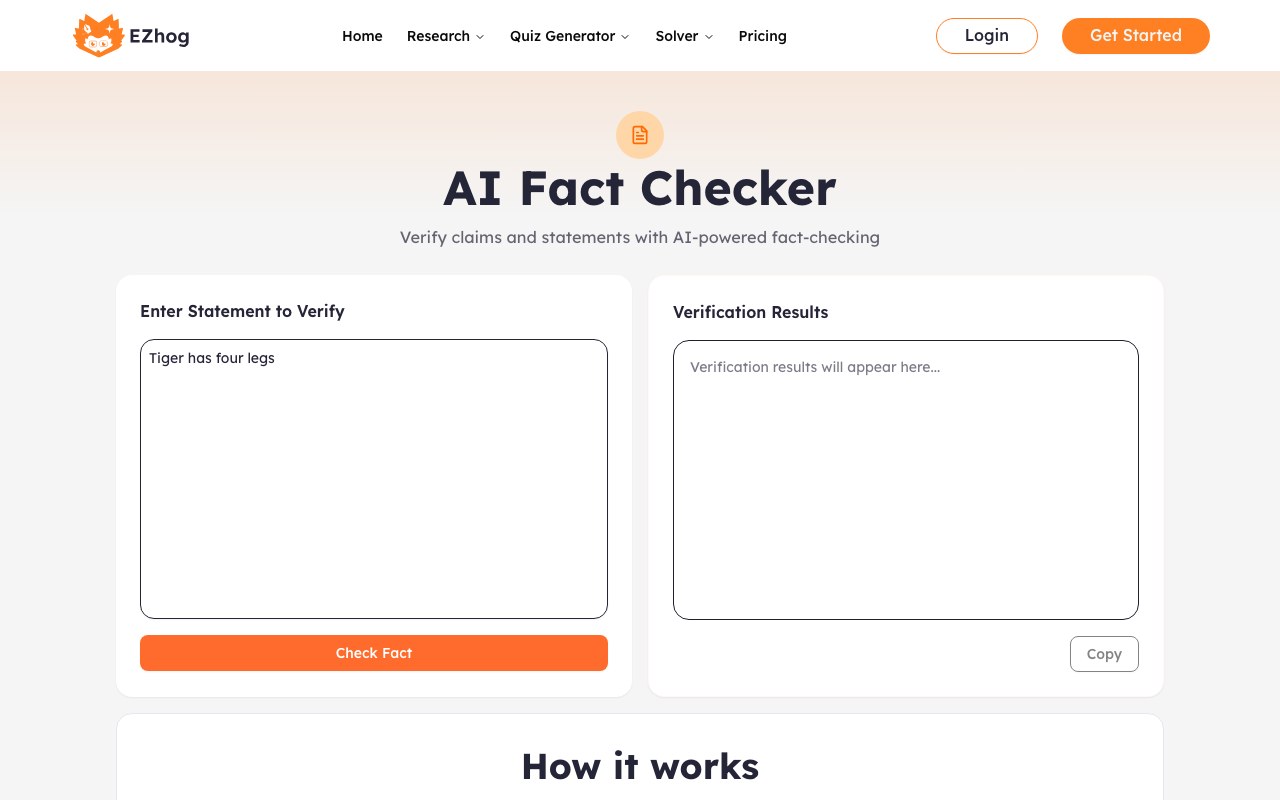
Use this claim verification tool for research & writing
Scan large texts, spot check-worthy statements, and flag uncertain claims fast.
Auto-monitor social/news feeds to detect rumors before they go viral.
Convert audio to text, match locations, & translate claims across languages.
Run self-review prompts to highlight uncertain or error-prone text.
Start with in-hand resources
Apply AI outcomes thoughtfully
Check all facts, citations, and calculations against institutional standards. Do not enter confidential research data or personal information into any public AI tool.
Common questions & answers
An AI fact checker can automatically scan, extract, and cross-reference claims against online sources to evaluate their truthfulness. It checks if a statement is true. It can detect claims in text or videos. It checks these claims against reliable sources. Then, it gives a real score and citations. Humans review this before trusting it.
Yes, AI fact-checkers can search the live web, not just old data. They break text into single claims. Then, they look for matching news and research. EZhog does this in real time. Plus, it gives clickable links. So, you can check the sources yourself.
AI fact-checkers rely on training cutoffs and real-time retrieval tools. This means their baseline knowledge is limited by their training cutoff. But many now access live web data.
Yes, it can detect and verify whether images or videos are AI-generated or manipulated. It checks for hidden watermarks and digital tags, like C2PA or SynthID. Also, it looks at pixels. The AI tools can spot odd shadows, lighting, or physics mistakes. Beyond that, they can trace a file's first appearance online using reverse image search and checkers.
AI fact-checkers handle tricky claims with care. They don't just say "true" or "false." First, they find checkable statements in text or speech. Then, they search for context and different viewpoints. They compare sources to see if experts disagree. If a claim is disputed, they explain why and show both sides.
You should not rely only on AI for medical, legal, or financial decisions. AI can help with basic research. But it can't replace experts. Sometimes, it makes up facts or fake citations. It sounds sure, even when wrong. Moreover, AI is not licensed or accountable like a real doctor or lawyer. Most importantly, it misses your personal context.