
Thesis & dissertation
Build strong, submission-ready titles with this thesis & dissertation title generator.
ACADEMIC RESEARCH AND WRITING
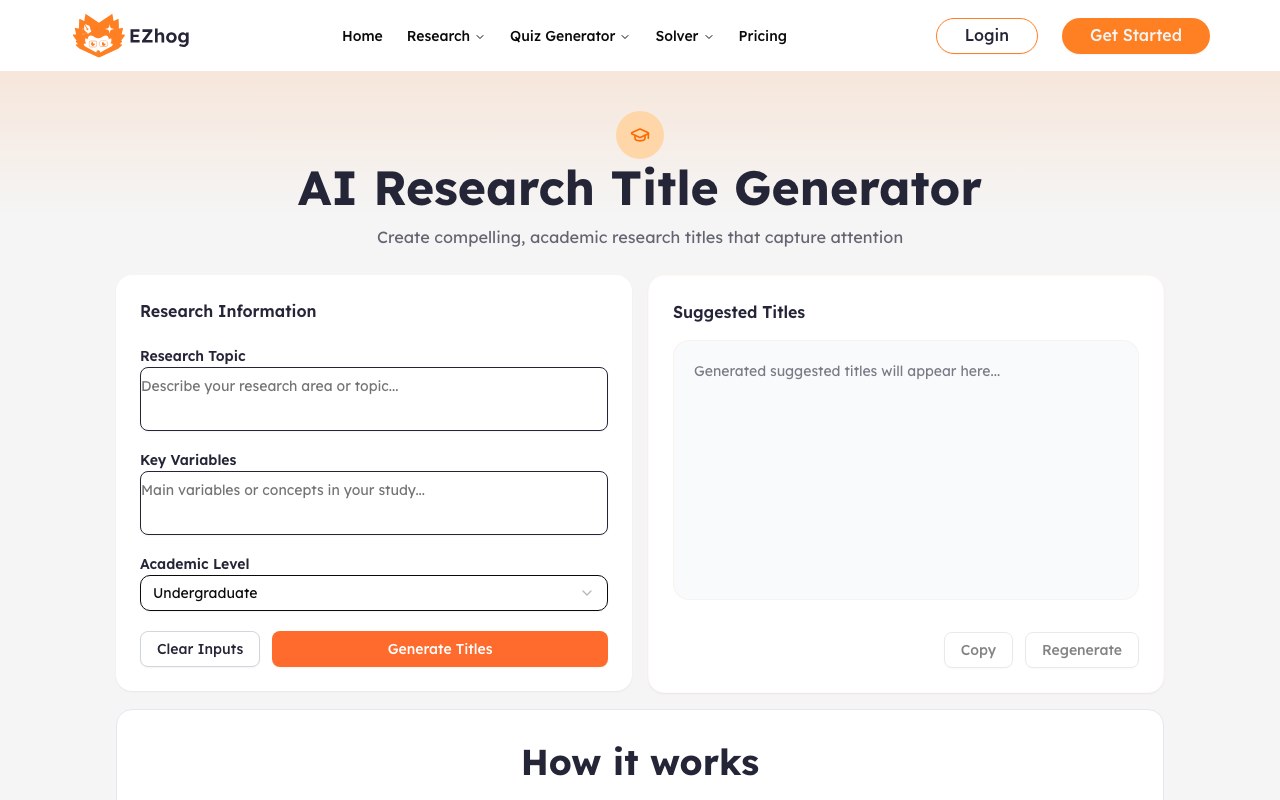
Turn your topic, variables, population, location, method, and style preferences into clear, specific research-title options.
The source and generated draft stay together so you can compare, verify, and refine the result without losing context.
From topic to title
Paste the text material or attach a supported document.
Focus on the settings that change the outcome.
Validate output against source, then copy or regenerate.
Single dedicated workspace
A two-panel layout keeps your original context in view alongside the result, settings, and checks.
Utilize thesis title generator for research & writing
Build strong, submission-ready titles with this thesis & dissertation title generator.
Paste your abstract into this platform and get a discipline-specific title instantly.
Automate brainstorming to teach students precise research scoping.
Improve search rankings on the scientific title generator using high-impact AI keywords.
Begin with your in-hand resources
Use AI results in a dedicated manner
Validate facts, citations, quotations, and calculations against institutional standards. Do not upload sensitive research data or personal information to public AI platforms.
Common questions & answers
A strong research title should • clearly reflect the core focus, • contains precise keywords, and • states the specific scope of your study.
You can generate a varying number of title options, such as 5-10 per prompt. It depends on which specific AI tool or platform you are using.
Yes, you can include main variables or concepts in your study while generating reasearch titles on EZhog’s AI generator.
The ideal research title length is 10 to 12 words. But a range between 10 and 15 words is widely accepted.
AI-generated titles are not guaranteed to be original. This is because language models predict text from patterns in massive training data. Sometimes, they recycle common phrases and familiar structures. Short titles are especially prone to accidental overlap with existing books, articles, or trademarks. Also, most basic AI tools skip real-time checks against live databases or trademark registries.
Yes, you can do this using advanced AI tools and large language models. For a formal style: ask the AI for precise academic terminology, declarative phrasing, or a two-part "Topic: Context and Impact" format. For a creative style: request engaging hooks, metaphors, or questions while keeping core keywords. Then, verify alignment with your journal or institution's guidelines.